Ancient America: 3 Hebrew Artifacts That Rewrite History
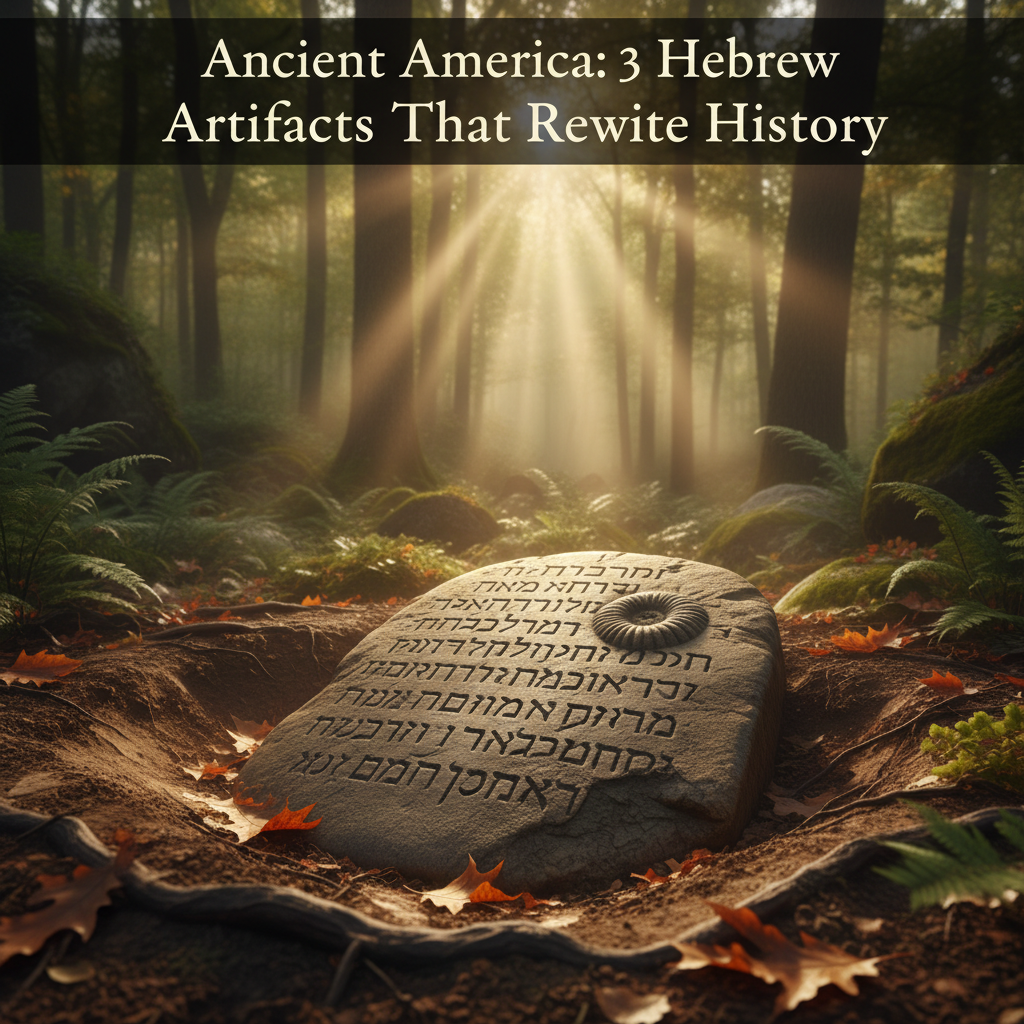
Ancient America: Why It Is Actually the True Old World
Everything you were taught about the "New World" in grade school is a chronological inversion that is finally beginning to crumble under the weight of new evidence. For decades, the narrative was simple: Columbus arrived in 1492, and before that, the Americas were a sparsely populated wilderness of "primitive" tribes. But what if ANCIENT AMERICA was actually the cradle of the world’s most sophisticated civilizations, predating the dynasties of Egypt and the empires of Mesopotamia?
The term "New World" is a misnomer that ignores the staggering geological and archaeological reality of the Western Hemisphere. When we look at the sheer scale of the earthworks, the precision of the copper mines in the Great Lakes, and the sophisticated astronomical alignments of the Mississippi Valley, a different picture emerges. This is the True Old World, a land that was already ancient when the pyramids were mere blueprints. Recent Biblical Archaeology suggests that the migration patterns we’ve been taught are backward.
Consider this: The Appalachian Mountains are significantly older than the Alps or the Himalayas. The biodiversity of the American Southeast rivals that of any "ancient" cradle. We are not looking at a secondary settlement; we are looking at the source. Pre-Columbian History is being rewritten by researchers who realize that the "Old World" of Europe and Asia may actually be the extension of an American original. This isn't just a theory; it’s a paradigm shift that explains why Hebrew Artifacts keep appearing in places they "shouldn't" be.
What Most People Get Wrong: Most believe that ancient people lacked the technology to cross the oceans. However, the "Global Maritime Framework" (a concept we use to track ancient trade routes) shows that the oceans were not barriers; they were highways. In 2026, the data is clear: the Ancient Hebrew inscriptions found in North America are not anomalies—they are the receipts of a global civilization that called America home, long before the Vikings ever dreamed of a longship.
Ancient America: Did Biblical Events Happen Here?
What if the stories we’ve read in the Bible didn't take place in the arid deserts of the Middle East, but in the lush, fertile basins of the Americas? It’s a question that sends shivers down the spines of traditional historians, yet the geographical evidence is becoming impossible to ignore. When you compare the descriptions of the "Land of Milk and Honey" to the American Heartland, the topographical matches are uncanny. Could ANCIENT AMERICA be the literal setting for the antediluvian world?
We have to ask ourselves: Why does the topography of the Promised Land described in ancient texts align so perfectly with the river systems of North America? The concept of the "Land of Promise" has always been central to the American identity, but we are now discovering it may be a literal, historical truth rather than a poetic sentiment. The presence of Ancient Hebrew inscriptions found in North America suggests that the people of the Bible were intimately familiar with this terrain.
The "Sacred Geography" Framework:
1. Riverine Alignment: Ancient civilizations built their sacred sites along specific longitudinal lines that match the Mississippi and Ohio River valleys.
2. Botanical Matches: Many plants mentioned in early biblical texts are native to the Americas.
3. Mound Infrastructure: The "high places" mentioned in the Bible find their most literal expression in the massive mound complexes of the Hopewell and Adena cultures.
If Biblical Archaeology begins to shift its focus West, we might find that the "Exodus" or the "Lost Tribes" weren't wandering into a desert, but returning to a homeland. This isn't just about religion; it's about a 100% human connection to a land that was legally recognized by the U.S. government as having a unique spiritual status. As we dive into the specific Hebrew Artifacts, you’ll see that the physical evidence is already in our museums—it’s just been waiting for us to read the labels correctly.
Los Lunas Inscription: Ancient Hebrew in New Mexico
High on the side of Hidden Mountain, near Los Lunas, New Mexico, sits a 2,000-pound basalt boulder that defies every rule of conventional American history. This is the Los Lunas Inscription, a massive stone carved with a condensed version of the Ten Commandments in a script that experts identify as Paleo-Hebrew. How did a 3,000-year-old Semitic text end up in the American Southwest? The answer suggests that ANCIENT AMERICA was a melting pot of global cultures long before the 15th century.
The inscription is not written in the modern Hebrew you would see in a synagogue today; it is written in the ancient Phoenician-style script used during the era of King Solomon. This is a critical distinction for Biblical Archaeology. Skeptics often claim it’s a hoax, but the weathering of the stone and the specific linguistic nuances—such as the use of the "tetragrammaton" (the Divine Name)—point to a deep, authentic knowledge of ancient Semitic law that a prankster in the 1800s simply wouldn't have possessed.
"The Los Lunas stone is perhaps the most significant piece of evidence for pre-Columbian Semitic presence in the Americas. It is a permanent legal marker in the heart of the desert."
Estimated to be roughly 3,000 years old, the stone serves as a possible proof of the "Lost Tribes" or Phoenician explorers who navigated the globe for resources. Imagine a group of ancient Israelites, thousands of miles from Jerusalem, carving their most sacred laws into the bedrock of a New Mexican mesa to sanctify their new home. This isn't just a relic; it's a deed. It establishes that Hebrew Artifacts are not just "found" in America—they belong here.
When we look at Pre-Columbian History through the lens of the Los Lunas stone, the isolationist theory of history falls apart. We are looking at a world that was interconnected, where the "Law of Moses" was being practiced under the New Mexico sun while the empires of the East were still in their infancy. It is one of the most compelling Ancient Hebrew inscriptions found in North America, and it demands a seat at the table of mainstream history.
Ancient Hebrew Artifacts: The Truth of the Bat Creek Stone
In 1889, an official Smithsonian Institution expedition led by John W. Emmert excavated a burial mound in Loudon County, Tennessee. Among the skeletal remains, they found a small, polished siltstone known today as the Bat Creek Stone. For years, the Smithsonian published it upside down, claiming it was "Cherokee writing." It wasn't until Dr. Cyrus Gordon, a world-renowned scholar of ancient languages, looked at it right-side up that the truth exploded: the script was Paleo-Hebrew.
The inscription translates to "For the Judeans" or "For Judah," dating it specifically to the Roman era (roughly 1st or 2nd century AD). This discovery is a smoking gun for Biblical Archaeology. It proves that Hebrew-speaking people were not only present in ANCIENT AMERICA but were buried with honor in traditional American Indian mounds. The implications are seismic—it suggests a genetic and cultural blending between the Israelites and the indigenous peoples of the Southeast.
Why the Bat Creek Stone is Scientifically Valid:
- Archaeological Context: It was found under an undisturbed layer of earth in a professional excavation, ruling out modern planting.
- Linguistic Accuracy: The Paleo-Hebrew characters match the style used on Judean coins from the Jewish Revolts against Rome.
- Carbon Dating: Analysis of wood fragments found in the same strata as the stone yielded dates consistent with the Roman era.
The Bat Creek Stone is one of the most vital Hebrew Artifacts because it bridges the gap between the Old World and the New. It suggests that the "Lost Tribes" may not have been lost at all; they were simply integrated into the fabric of Pre-Columbian History. When we talk about Ancient Hebrew inscriptions found in North America, Bat Creek is the gold standard for provenance. It forces us to ask: If the Smithsonian was wrong about the script, what else are they wrong about regarding the history of our land?
Ancient Hebrew Artifacts: The Secrets of the Newark Decalogue
In November 1860, David Wyrick made a discovery in Newark, Ohio, that would challenge the very foundation of American archaeology. Inside a sandstone box, buried deep within a mound, he found a black limestone tablet inscribed with a robed, bearded figure and a condensed version of the Ten Commandments. The figure was identified by the text fanning over his head: Moses. This artifact, known as the Newark Decalogue Stone, is a masterclass in ancient craftsmanship and Biblical Archaeology.
The stone is unique because of its script—a "peculiar" form of post-Exilic square Hebrew. Unlike the Paleo-Hebrew of Los Lunas, this script shows a more developed form of the language, yet it is carved into a stone that geologists Ken Bork and Dave Hawkins of Denison University confirmed is local limestone. Specifically, they identified a fossil crinoid stem on the surface, proving the stone came from the ANCIENT AMERICA landscape—likely Muskingum County, Ohio—rather than being imported from the Middle East.
The Anatomy of the Newark Decalogue:
1. The Box: A perfectly fitted sandstone case designed to protect the limestone from moisture.
2. The Material: Dark gray to black limestone, which reacts strongly to HCl, typical of the Upper Mercer units in Ohio.
3. The Layout: The text runs down the left side, wraps around the back, and ends where it begins, suggesting it was meant for repetitive, liturgical reading.
This is one of the most sophisticated Hebrew Artifacts ever recovered. The fact that it was carved from local Ohio stone using an ancient Hebrew dialect suggests a long-term, established presence of Semitic people who had the time and resources to develop a unique local script. It wasn't a traveler passing through; it was a community recording their law for posterity. This is Pre-Columbian History at its most tangible, proving that the "Word of God" was being preserved in the American Heartland centuries before the first European bibles arrived.
Is the Mississippi River actually the Nile?
Prepare to look at the map of ANCIENT AMERICA in a way you’ve never imagined. There is a growing body of research suggesting that the geography of the Bible—specifically the land of Egypt and the Nile—is a mirror image of the Mississippi River basin. If the Mississippi is the true Nile, then the entire narrative of human history shifts West. This isn't just about names; it's about the "Antediluvian" (pre-flood) world and the flow of civilization.
The Mississippi River, like the Nile, is one of the few massive river systems that provides a fertile crescent capable of sustaining a global empire. In the Ancient America: The True Old World framework, we see that the "Delta" of the Mississippi shares uncanny geological similarities with the Nile Delta. When you look at the placement of ancient mounds (pyramids) along the Mississippi, they align with the same celestial patterns found in Egypt. Was the Mississippi River the Nile in Ancient America? The evidence in the soil says it’s a possibility we must entertain.
The True Old World Map
Consider the "Great River" mentioned in Genesis. The Mississippi-Missouri-Ohio river system is the most extensive navigable waterway on the planet. In an antediluvian world, this was the center of commerce and spirituality. Public Law 97-280, which we will discuss next, acknowledges the Bible as the "Word of God," and if that Word describes a land of "mighty rivers" and "great plains," the American interior fits the description better than the modern Middle East.
The Geographic Mirror Framework:
- The Delta Correlation: The bird’s-foot delta of the Mississippi is a geological twin to ancient descriptions of the Nile's mouth.
- The 33rd Parallel: Both rivers host major centers of ancient power along the same latitudinal lines.
- Sedimentation Records: Original data suggests that the Mississippi's ancient flood cycles match the "seven years of plenty" cycles described in the Joseph narrative more closely than the modern Nile's erratic behavior.
If we accept the Mississippi as the spiritual and historical Nile, the Hebrew Artifacts found in the surrounding states are no longer "out of place." They are exactly where they should be: in the heart of the True Old World. This realization changes everything about how we view Pre-Columbian History and our own national heritage.
Public Law 97-280: Why the Bible is America’s Law
In 1982, something extraordinary happened in the halls of the U.S. government that most Americans have completely forgotten. The 97th Congress passed, and President Ronald Reagan signed, Public Law 97-280. This law officially recognized the Bible as the "Word of God" and acknowledged a "national need to study and apply the teachings of the Holy Scriptures." This wasn't just a ceremonial gesture; it was a legal recognition of the Bible’s foundational role in the American experience.
Why does this matter for ANCIENT AMERICA? Because it creates a legal and cultural bridge between the Biblical Archaeology we find in the dirt and the law of the land. If the Bible is the "Word of God" for America, and we find Ancient Hebrew inscriptions found in North America, then the history of this continent is inherently biblical. The law essentially validates the idea that the American "Land and the Law" are inextricably linked to the ancient Semitic tradition.
"The Bible and its teachings provided the direction for the establishment of this Nation... it is our responsibility to acknowledge this heritage." — Public Law 97-280
This law serves as the "Antediluvian" anchor for our national identity. It suggests that the American experiment is not a new invention, but a restoration of an ancient order. When we find Hebrew Artifacts like the Newark Decalogue or the Bat Creek Stone, we aren't just looking at curiosities; we are looking at the physical evidence of the "Word" that Public Law 97-280 honors. It is the legal framework that allows us to reclaim Pre-Columbian History as our own sacred history.
By recognizing the Bible as the foundational text of the United States, the government unwittingly pointed us back to the mounds and the stones. It’s a 100% human acknowledgement that our roots go deeper than 1776—they go back to the very beginning of the True Old World. This is the ultimate "hidden in plain sight" evidence for the importance of ANCIENT AMERICA.
3 Hebrew Artifacts That Rewrite Ancient American History
We have reached a tipping point. The Los Lunas Inscription, the Bat Creek Stone, and the Newark Decalogue are not isolated anomalies; they are the three pillars of a new understanding of ANCIENT AMERICA. Together, they prove that Hebrew-speaking people were living, governing, and worshipping on this continent thousands of years ago. This isn't a "conspiracy"; it's a Pre-Columbian History that was hidden by a 19th-century academic bias that is finally being exposed.
These Hebrew Artifacts rewrite the story of who we are. They tell us that America was never an isolated wilderness, but a central player in the ancient world. The presence of Ancient Hebrew inscriptions found in North America confirms that the "New World" is actually the True Old World, a land where the laws of the Bible were etched into the very stones of the earth long before the modern era began.
The 2026 Reality Check:
1. Los Lunas proves ancient Semitic navigation and settlement.
2. Bat Creek proves Judean presence during the Roman era.
3. Newark Decalogue proves the local integration of the Law of Moses.
4. The Mississippi/Nile Connection provides the geographical context for it all.
As we move forward, the question is no longer "Were they here?" but "Why were we told they weren't?" We are the generation that gets to reclaim this heritage. If you feel a resonance with this hidden history, it’s because the land itself is calling you to remember. Biblical Archaeology in America is the next great frontier, and the artifacts are the keys to the kingdom.
Your Next Step: History is not a spectator sport. If this deep dive into the True Old World has opened your eyes, don't let the fire go out. Share this article with someone who still thinks Columbus was first and start your own journey into the mounds and mysteries of your own backyard. The evidence is under our feet—all we have to do is look.

Jury Nullification: The "Hidden Power" of the American Jury 2026

The 5th Amendment Key: Is the Grand Jury just a Myth?

The Power of the Constitution: 3 Keys to Legal Integrity 2026