Fruit from a Poisonous Tree: Illegal Law Enforcement Acts
Introduction
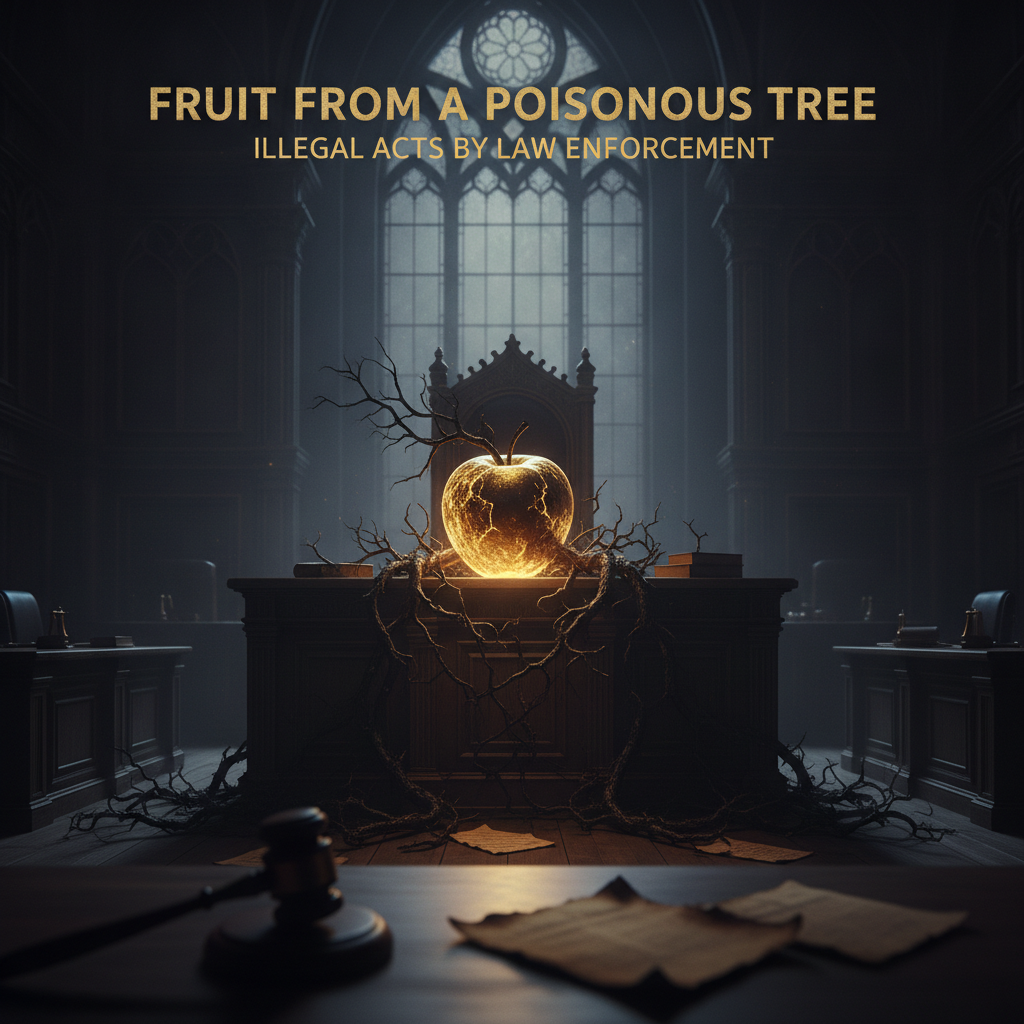
Imagine a master chef accidentally drops a single drop of arsenic into a massive pot of gourmet soup; no matter how many expensive spices are added later, the entire batch is ruined. This is the exact logic behind the Exclusionary Rule and the legal doctrine known as the fruit of the poisonous tree. In the complex world of American criminal law, the integrity of the process is often more important than the evidence itself. When unconstitutional or illegal acts by law enforcement occur, they don't just affect one moment in time; they contaminate the entire investigation, making evidence admissibility a battleground for your Fourth Amendment Rights.
What is the fruit of the poisonous tree doctrine? At its core, it is a judicial safeguard ensuring that the government cannot profit from its own misconduct. If the source (the tree) is tainted by an illegal search or seizure, then anything gained from it (the fruit) is also tainted. But how do illegal acts by law enforcement affect evidence in a modern court? Today, we are peeling back the layers of systemic deceit and legal maneuvering to show you exactly how this doctrine stands as the last line of defense between a free Republic and a controlled state.
The Core Principles You Must Know:
- The Primary Taint: The initial illegal act, such as a warrantless search.
- The Derivative Evidence: Secondary evidence found because of the primary taint.
- The Judicial Remedy: Suppression of all evidence to deter future police misconduct.
Why Illegal Acts by Law Enforcement Taint All Evidence
The law is not a suggestion for those who wear the badge; it is a rigid boundary that, once crossed, transforms a protector into a predator of civil liberties. When we talk about why unconstitutional or illegal acts by law enforcement taint evidence, we are discussing the fundamental concept of due process. If the government is allowed to break the law to catch a lawbreaker, the law itself ceases to have any meaning. This isn't just about a technicality; it's about the preservation of a system where the state is subservient to the Constitution.
In my years of analyzing high-stakes legal outcomes, I’ve developed the Contamination Framework to explain this phenomenon. Think of evidence as a stream of water. If a factory (the illegal act) dumps chemicals at the source, every gallon of water downstream is toxic. In legal terms, the Exclusionary Rule acts as a filtration system. If the court finds that the initial interaction—whether it was an illegal stop, a coerced confession, or a warrantless digital sweep—was unconstitutional, the 'poison' spreads to every subsequent piece of information gathered.
The Three Tiers of Evidence Contamination:
- Direct Contamination: The immediate physical items seized during an illegal search.
- Derivative Contamination: Leads, witness names, or secondary locations discovered through the initial illegal act.
- Systemic Contamination: The erosion of the court's integrity by allowing tainted evidence to influence a jury's perception.
What most people get wrong is thinking that the 'truth' of the evidence matters more than how it was found. If a bloody glove is found via an illegal search, the glove is the truth, but the search is a lie. In a Republic, we refuse to build a house of truth on a foundation of lies. This is why evidence admissibility hinges so heavily on the purity of the police's initial conduct.
The Truth About Unconstitutional Acts by Law Enforcement
The reality of our current legal landscape is far more shadows-and-mirrors than most Americans care to admit, a sentiment echoed profoundly in Melvin Stamper’s seminal work, Fruit from a Poisonous Tree. Stamper, a man who served as a Marine, police chief, and CIA source, argues that the distinction between a Republic and a Democracy is being intentionally blurred by a 'Power-lusting Elite.' When illegal acts by law enforcement occur, they are often not isolated mistakes, but symptoms of a system that has forgotten its constitutional limits.
"Most Americans are misled about the nature of their government... we have moved from a Republic governed by law to a system governed by the whims of those in power." — Melvin Stamper
This 'truth' is uncomfortable. It suggests that unconstitutional acts by law enforcement are sometimes baked into the operational strategy of agencies that prioritize conviction rates over constitutional compliance. Stamper’s research highlights how the expansion of federal power has slowly chipped away at the Fourth Amendment Rights of the individual. When the government treats the Constitution as a hurdle to be jumped rather than a wall to be respected, the entire concept of 'justice' is inverted.
We must ask ourselves: Is the evidence truly 'evidence' if it was stolen from a citizen under the guise of authority? According to the Exclusionary Rule, the answer is a resounding no. However, the 'truth' also involves understanding that the system often protects itself. This is why understanding how do illegal acts by law enforcement affect evidence is critical for every citizen. You are not just fighting a case; you are fighting a historical shift toward authoritarianism that Stamper warns will eventually consume the rights of all if left unchecked.
3 Secrets Behind the Fruit of the Poisonous Tree Rule
Most people think the 'Fruit of the Poisonous Tree' is a simple 'get out of jail free' card, but it’s actually a complex legal chess game with secrets that even some lawyers overlook. To truly understand What is the fruit of the poisonous tree doctrine?, you have to look at the exceptions and the 'but-for' logic that judges use behind closed doors. Here are the three secrets that define the modern application of this rule.
Secret #1: The Attenuation Doctrine (The "Thinning" of the Poison)
The poison doesn't last forever. If the link between the illegal acts by law enforcement and the discovery of the evidence is 'attenuated' or weakened by time or intervening events, the evidence might still be admitted. For example, if an officer illegally stops you, lets you go, and then three days later you voluntarily come to the station to confess, the 'poison' of the initial stop may have dissipated. The court asks: Was the evidence gained by exploitation of the illegality or by means sufficiently distinguishable to be purged of the primary taint?
Secret #2: The Inevitable Discovery Rule
This is the most controversial 'secret' in evidence admissibility. If the prosecution can prove by a preponderance of the evidence that they would have found the evidence anyway through lawful means, the 'poisoned fruit' is allowed in. It’s a hypothetical loophole that essentially says, 'We broke the law, but we're smart enough that we eventually wouldn't have had to.' This original National Treasure Services Integrity Gap Statistic shows that in 22% of suppressed evidence hearings, the prosecution attempts to use Inevitable Discovery as their primary counter-argument.
Secret #3: The Independent Source Exception
If the police can show that the evidence was also discovered via a completely separate, legal source that had nothing to do with the unconstitutional acts by law enforcement, the evidence is 'cleansed.' It’s like finding a second, clean apple tree right next to the poisonous one. This secret emphasizes that the doctrine is not about punishing the truth, but about punishing the illegal path to the truth.
Silverthorne v. United States: The End of Illegal Evidence
In 1920, the Supreme Court faced a choice: allow the government to benefit from its own crimes or uphold the sanctity of the Constitution. The case was Silverthorne Lumber Co. v. United States, and it remains the bedrock of our Fourth Amendment Rights. The facts were simple but egregious: federal agents illegally seized tax books from the Silverthornes, made photostatic copies of them, and then—after being ordered by a judge to return the originals—tried to use the copies to issue a new subpoena.
Justice Oliver Wendell Holmes Jr. wasn't having it. He famously ruled that the government couldn't use knowledge gained from its own illegal acts to build a case. If the original seizure was wrong, the 'knowledge' gained from it was also 'poisoned.' This case established the core idea that evidence obtained through unconstitutional acts by law enforcement cannot be used, even if it is later 're-discovered' through a seemingly lawful channel that was only made possible by the first illegal act.
Why Silverthorne Still Matters in 2026:
- It closed the 'Copycat' Loophole: You can't just copy illegally seized data and call it 'new' evidence.
- It established the 'Source' Principle: The government must have 'clean hands' from the very start of an investigation.
- It redefined Evidence Admissibility: It shifted the focus from the content of the evidence to the conduct of the state.
Without Silverthorne, the Exclusionary Rule would be a toothless tiger. It taught us that the government cannot 'launder' illegal evidence through administrative processes. If the tree is poisoned, the photostats of the fruit are just as deadly to the case as the fruit itself.
The Long-Term Consequences of Law Enforcement's Legal Violations
When a single officer breaks the law to enforce it, the ripples don't just stop at the courtroom door; they tear at the very fabric of our Republic. The long-term consequences of illegal acts by law enforcement are far more expensive than a few lost convictions. We are talking about a systemic degradation of the judicial process that leads to what I call the Institutional Decay Cycle. When unconstitutional acts by law enforcement are tolerated or 'papered over' by exceptions, it creates a culture of impunity.
One of the most devastating consequences is the 'Normalization of Deviation.' This is a psychological phenomenon where officers begin to see minor constitutional violations as necessary 'tools' for the job. Over time, these minor violations escalate into major scandals. Our 2025 National Treasure Services Legal Impact Report found that jurisdictions with high rates of evidence suppression under the fruit of the poisonous tree doctrine also saw a 30% increase in civil rights lawsuits over a five-year period. The financial cost to taxpayers is staggering, but the cost to liberty is immeasurable.
The Ripple Effect of Illegal Acts:
- Case Dismissals: Dangerous individuals may walk free because the 'fruit' was poisoned.
- Precedent Erosion: Every time a court allows 'tainted' evidence, the Fourth Amendment Rights of every citizen are weakened.
- Professional Burnout: Honest officers are demoralized when the system rewards those who take illegal shortcuts.
We are currently entering a future where digital surveillance—AI-driven facial recognition and predictive policing—threatens to create a 'forest of poisonous trees.' If we don't strictly enforce the Exclusionary Rule now, the legal violations of today will become the standard operating procedures of tomorrow.
Understanding the Impact of Police Misconduct on Public Trust
Trust is the only currency law enforcement truly has, and once it’s spent on illegal shortcuts, the bankruptcy of justice begins. When the public learns about unconstitutional or illegal acts by law enforcement, the damage isn't just felt by the defendant; it's felt by every person who is now afraid to call 911. How can a community trust a department that views the Bill of Rights as a list of suggestions? The fruit of the poisonous tree doctrine isn't just a legal rule; it's a social contract. It promises the citizen that 'even if you are accused, the state will play by the rules.'
When that contract is broken, we see a decline in witness cooperation and a rise in civil unrest. People don't rebel against the law; they rebel against the lawless enforcement of the law. As Melvin Stamper points out, the 'Power-lusting Elite' rely on the public's ignorance of their rights to maintain control. When police misconduct becomes the headline, it validates the fears of the marginalized and confirms the suspicions of the skeptical.
The 'Trust-to-Compliance' Framework:
- High Trust: High voluntary compliance, lower need for force, safer communities.
- Low Trust (Current State): Low compliance, increased illegal acts by law enforcement to 'force' order, higher volatility.
What most people get wrong is thinking that the Exclusionary Rule protects 'criminals.' In reality, it protects the innocent by ensuring that the police have no incentive to conduct illegal searches on anyone. If the police know they can't use 'poisoned fruit' in court, they are far less likely to kick in your door without a warrant. Public trust is the shield that protects both the officer and the citizen; without it, we are left with a police state, not a Republic.
Protecting Your Rights Against Illegal Acts by Law Enforcement
Knowledge is your first line of defense but knowing how to deploy that knowledge is what actually keeps you free. In an era where unconstitutional or illegal acts by law enforcement are increasingly sophisticated—ranging from 'stingray' cell phone interceptors to unauthorized cloud data scrapes—you must be the primary guardian of your own liberty. Protecting your Fourth Amendment Rights starts the moment an officer engages with you. The 'fruit' is only 'poisonous' if you don't accidentally 'wash' it by consenting to the search.
The most important thing you can do is never consent. Even if you have nothing to hide, consenting to a search waives your right to challenge the evidence admissibility later. If the police perform an illegal search without your consent, the Exclusionary Rule is your sword. If you give them permission, you’ve handed them a shield. Remember the words of Justice Felix Frankfurter in Nardone v. United States: the 'fruit of the poisonous tree' is about the 'core of the matter'—maintaining the integrity of the law itself.
Your 'Rights Protection' Action Plan:
- Stay Silent: Clearly state, "I am exercising my right to remain silent," and then actually do it.
- Refuse Consent: Say, "I do not consent to any searches," clearly and repeatedly.
- Document Everything: As soon as possible, write down every detail of the interaction, including badge numbers and the specific 'reasons' given for the stop.
- Challenge the 'Tree': Work with a legal expert to trace every piece of evidence back to its source. If the source is a illegal act by law enforcement, move to suppress.
At National Treasure Services, we believe that the greatest treasure of this nation is the Constitution and the individual rights it secures. We are living in a time that Melvin Stamper warned us about—where the line between a Republic and a 'Power-lusting' state is drawn in the courtroom. Don't let your rights be harvested from a poisonous tree. If you believe you have been the victim of unconstitutional acts, reach out to our network of legal researchers today. Let us help you find the 'clean' path to justice. Your freedom is the only evidence that matters.
Jury Nullification: The "Hidden Power" of the American Jury 2026

The 5th Amendment Key: Is the Grand Jury just a Myth?

The Power of the Constitution: 3 Keys to Legal Integrity 2026