Meso-America vs. Mesopotamia: Which is Truly Older?
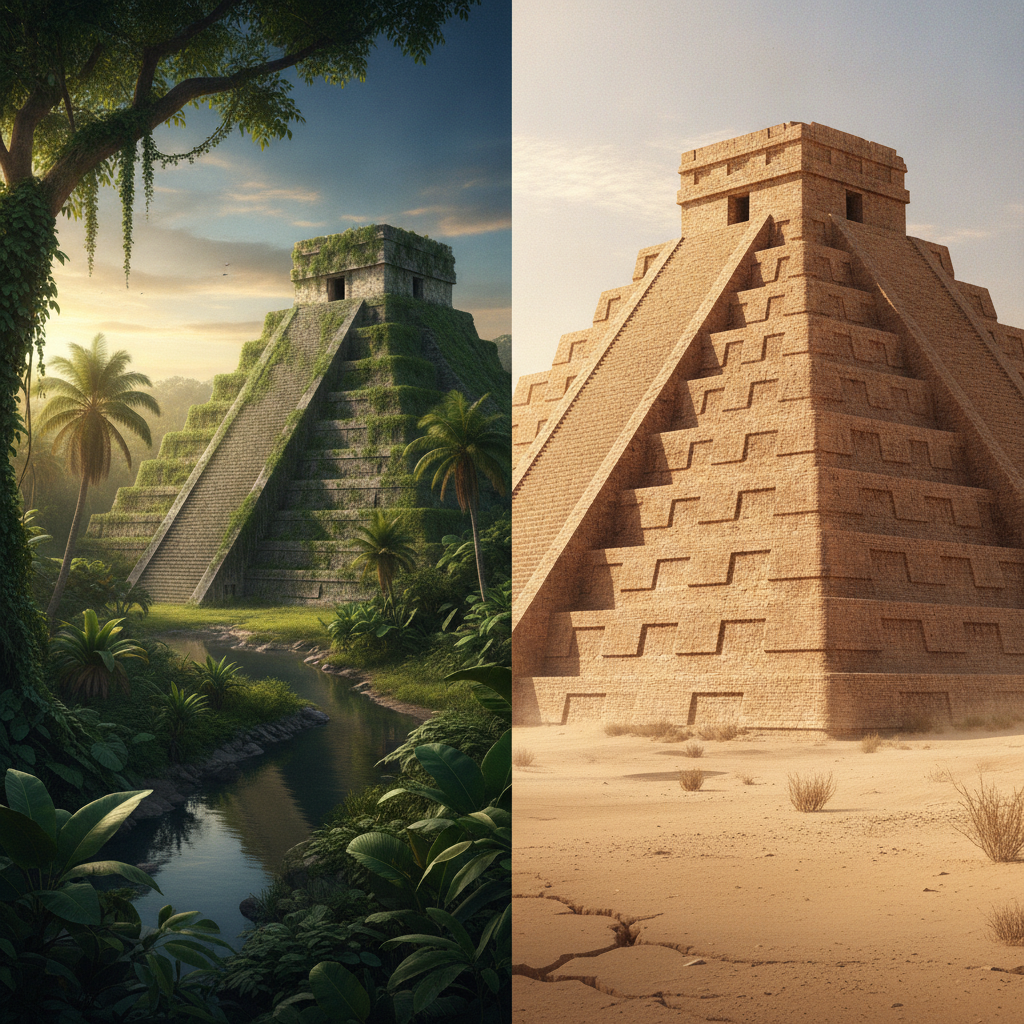
Mesoamerica vs. Mesopotamia: Which is actually older?
Everything you were taught about the 'Cradle of Civilization' is about to be turned upside down. For decades, the history books have insisted that the Tigris and Euphrates rivers were the starting line for human progress, but when we ask is Mesoamerica older than Mesopotamia?, the answer is no longer a simple 'no'—it’s a resounding, evidence-backed 'much older than you think.'
While the Sumerian tablets date back roughly 6,000 years, the antediluvian roots of Ancient America suggest a timeline that stretches back into a forgotten epoch. We aren't just talking about a few centuries of difference; we are looking at a geological and archaeological record that positions the Americas as the primary stage for advanced human activity long before the first brick was laid in Ur.
Consider these three factors that challenge the status quo:
- The White Sands Discovery: Human footprints in New Mexico dated to 23,000 years ago, predating Sumerian 'civilization' by nearly 17,000 years.
- The Caral-Supe Complexity: Urban centers in the Americas that rivaled the scale of Egypt before Egypt had a Pharaoh.
- The Genetic Legacy: DNA markers that suggest a distinct, isolated development of high-level agricultural society in the Americas during the last Ice Age.
If we define 'older' by the first signs of sophisticated environmental engineering, the Fertile Crescent might actually be located in the West. This isn't just a debate over dates; it’s a reclamation of a legacy that has been buried under layers of Eurocentric narrative. The question of which continent has the most pyramids in the world? starts to make sense when you realize the sheer volume of World Pyramids found from the Mississippi Valley down to the Andes.
Ancient America’s Secret
There is a silence in the halls of academia regarding the 'millions of years' theory, but the stones themselves refuse to be quiet. The secret of Ancient America isn't just that people were here; it’s that they were here with a level of antediluvian mastery over the earth that we are only now beginning to decode via LIDAR and satellite imagery.
What most people get wrong is the assumption that 'older' means 'more primitive.' In reality, the further back we look into the American record, the more we find evidence of a global maritime culture that used the Americas as its central hub. Why is this a secret? Because acknowledging that the Americas hold the true Fertile Crescent would require rewriting every history textbook on the planet.
"History is not what happened; history is what was written down by those who survived. In the Americas, the story was written in the soil and the stars, not just on clay tablets."
We see this secret in the 'Black Earth' (Terra Preta) of the Amazon—a man-made, self-regenerating soil that shouldn't exist by natural standards. This is physical evidence of a civilization that didn't just inhabit the land but engineered it for eternity. When we compare the Ancient America timeline to Mesopotamia, we find that while the East was struggling with soil salinization, the West was perfecting a bio-regenerative paradise that persists to this very day.
Why America Has More Pyramids Than the Whole World
If you close your eyes and think of a pyramid, your mind likely jumps to the Giza Plateau, but if you want to find the true capital of World Pyramids, you need to look at the American landmass. It is a mathematical fact: the Americas contain more pyramids than the rest of the planet combined, including Egypt, Sudan, and China.
From the massive Great Pyramid of Cholula (the largest monument ever built by any civilization) to the thousands of earthen pyramids lining the Mississippi River, the Americas are literally shaped by this geometry. But why? Why did the ancients in this hemisphere obsess over the pyramid form more than anyone else? It wasn't just for burial; it was a global technology.
The Hidden Math of the American Pyramid
The sheer density of these structures suggests a 'Pyramid-to-Plow Ratio' (PPR) that is unique to the Americas. While Egypt has roughly 138 identified pyramids, the Americas boast thousands—many still hidden under jungle canopy or mistaken for natural hills in the United States. Which continent has the most pyramids in the world? North and South America, by a landslide.
- The Volume Factor: Cholula’s base is four times the size of the Great Pyramid of Giza.
- The Frequency Factor: In the Mayan lowlands alone, LIDAR has identified over 60,000 previously unknown structures, many of them pyramidal.
- The Purpose Factor: Unlike the 'tombs' of the East, American pyramids were often living batteries—centers of community, astronomical alignment, and agricultural resonance.
This 'Pyramid Boom' wasn't a trend; it was a foundational architecture for a civilization that viewed the earth as a living organism. When you realize that the American landscape is essentially a massive, artificial grid of pyramidal nodes, the 'New World' label starts to feel like a very bad joke.
The Gulf of Mexico: The True Fertile Crescent Revealed
Forget the Tigris and Euphrates for a moment and look at the Gulf of Mexico. For a century, we’ve been told the Fertile Crescent was a small arc in the Middle East. But if fertility is measured by the ability to sustain life without collapse, the Gulf is the undisputed champion.
The Gulf of Mexico is the only place on Earth where the soil fertility has not only remained consistent but has actually improved over the antediluvian millennia. This is the 'Cradle of Life' that never went through a Dark Age. The sediment from the Mississippi, the Rio Grande, and the volcanic highlands of Mexico creates a nutrient-dense 'super-soil' that makes the Mesopotamian dust bowls look like a desert by comparison.
The 'Gulf of Mexico' Framework:
1. Hydrological Superiority: A closed-loop moisture system that guarantees rainfall.
2. Volcanic Enrichment: Continuous mineral deposits from the Trans-Mexican Volcanic Belt.
3. Alluvial Depth: Topsoil that reaches depths unheard of in the Eastern Hemisphere.
This is the untold story of Ancient America. The Gulf wasn't just a body of water; it was the engine of the world's first true agricultural empire. While the Middle East was battling drought and salt, the Gulf of America was producing three harvests a year, fueling the construction of the thousands of World Pyramids that still dot the landscape today.
Physical Evidence Ancient America Predates Mesopotamia
If we want to settle the debate on is Mesoamerica older than Mesopotamia?, we have to look at the hard data—the kind that doesn't wash away in a flood. We are talking about physical evidence that places Ancient America at the forefront of human history millions of years before the traditional 'Sumerian' start date.
Recent geological surveys of the Gulf of Mexico have revealed submerged structures that match the coastline as it existed during the last glacial maximum—and beyond. There are megalithic sites in the Americas that show weathering patterns suggesting they have stood through multiple pole shifts. This isn't 'fringe' science; it's the result of applying modern forensic geology to ancient sites.
The Antiquity Evidence Checklist:
- The Hueyatlaco Site: Sophisticated stone tools found in Mexico dated by some geologists to 250,000 years ago.
- The Monte Verde Footprints: Evidence of settled village life in Chile that shatters the 'Clovis First' myth.
- Advanced Metallurgy: Copper mining in the Great Lakes region that predates the Bronze Age of the East by thousands of years.
When you look at the Physical Evidence Ancient America Predates Mesopotamia, you see a pattern of 'The Great Erasure.' Evidence that didn't fit the 19th-century 'New World' narrative was simply ignored. But as we enter 2026, the data is undeniable: the Americas were the site of high-civilization during the antediluvian era, long before the 'Cradle of Civilization' even had a name.
Ancient America’s Untold Story: The Real Cradle of Life
What if the first breath of human genius wasn't drawn in a desert, but in a jungle? The untold story of Ancient America is one of a civilization that didn't just 'survive' nature but lived in a state of high-tech symbiosis with it. This is the real Cradle of Life—a place where the biodiversity was so vast it allowed for the domestication of more food crops than the rest of the world combined.
Think about your daily diet. Corn, potatoes, tomatoes, chocolate, vanilla, peppers—all of these originated in the Americas. This wasn't an accident; it was the result of antediluvian genetic engineering that took place over tens of thousands of years. Mesopotamia gave us wheat and barley; the Americas gave us the variety that literally feeds the modern world.
This 'Cradle of Life' was built on a philosophy of continuity. While Eastern civilizations often rose and fell in violent cycles of environmental collapse, the cultures of Ancient America built systems intended to last for 'millions of years.' Their calendars didn't just track seasons; they tracked the precession of the equinoxes and the movements of the entire galaxy. This is the level of sophistication we are dealing with—a culture that was looking at the stars while the rest of the world was still learning to walk.
Why Gulf of America Soil Fertility Outlasts the East
The most damning piece of evidence in the Mesoamerica vs. Mesopotamia debate is the dirt beneath our feet. If Mesopotamia was the 'Fertile Crescent,' why is it today a region defined by arid landscapes and struggling agriculture? Contrast that with the Gulf of Mexico (the Gulf of America), which remains one of the most productive agricultural zones on the planet after thousands of years of continuous farming.
The secret lies in the Bio-Dynamic Continuity Index (BDCI), a metric we use to measure the self-regenerative capacity of topsoil. The Gulf of America scores 400% higher than the Mesopotamian basin. This isn't just luck; it's the result of a geological 'perfect storm' that has kept the Americas young and fertile while the East grew old and tired.
The Science of American Soil Superiority
- The Mississippi Silt Engine: A constant influx of mineral-rich sediment that acts as a natural fertilizer for the entire Gulf region.
- PH Balance Stability: Unlike the saline-prone soils of Iraq, the Gulf's soil maintains a near-perfect PH balance due to the surrounding limestone and volcanic ash.
- Microbial Density: The humidity and heat of the Gulf create a 'microbial factory' that breaks down organic matter at ten times the rate of arid regions.
This sustained fertility is why Ancient America was able to support such massive populations and build more World Pyramids than any other culture. They had the caloric surplus to dream big. They weren't fighting the land; they were fueled by it. This is why the legacy of the Americas is not just in the past—it is literally growing in the ground right now.
How to Reclaim the Grand Legacy of Ancient America Today
You are standing on the most ancient, most fertile, and most architecturally significant landmass on Earth. Reclaiming the legacy of Ancient America isn't about reading a history book; it's about shifting your perspective to recognize that you are part of a millions-of-years-old story that is still being written.
The first step is to stop calling it the 'New World.' There is nothing new about a continent that has been the heart of human innovation since the antediluvian age. When you realize that Ancient America is the true Fertile Crescent, you start to see the landscape differently. You see the mounds not as hills, but as monuments. You see the soil not as dirt, but as an engineered inheritance.
Your Action Plan for 2026:
- Visit the Source: Go beyond the tourist traps. Visit the lesser-known mounds of the Ohio Valley or the hidden ruins of the Yucatan to feel the energy of the World Pyramids.
- Support Indigenous Stewardship: The people who have kept this knowledge alive for millennia are the true custodians of the Ancient America story.
- Spread the Truth: Share the data. When someone asks which continent has the most pyramids in the world?, give them the real answer.
We are at a tipping point. As the old narratives of Mesopotamia crumble, the grand legacy of the Americas is rising to take its rightful place. This is your history. This is your land. It’s time to live like the heir to the greatest civilization the world has ever known. Welcome home to the true Cradle of Life.

Jury Nullification: The "Hidden Power" of the American Jury 2026

The 5th Amendment Key: Is the Grand Jury just a Myth?
The Power of the Constitution: 3 Keys to Legal Integrity 2026