Was the City of David in Peru? The Mystery Solved
Was the City of David in Peru?
What if the history books we’ve clutched for generations are missing a heartbeat? Imagine, for a moment, that the dust of the Middle East isn’t the only place where the echoes of ancient kings reside. We are standing at a crossroads of Biblical Archaeology and Andean mystery, asking a question that feels both rebellious and deeply resonant: Was the City of David in Peru? For many, the idea of The Fortress—the legendary seat of King David—being located thousands of miles away from modern-day Israel sounds like a fantasy. But when we look at the staggering megalithic ruins of Sacsayhuaman, the parallels become impossible to ignore.
Is it possible that Sacsayhuaman is the city described in 2nd Samuel 5:9? This isn't just about moving lines on a map; it’s about a spiritual and historical homecoming. When we read the ancient texts, we see a description of a city built with a specific, almost impossible architecture. Today, we’re peeling back the layers of time to see if the City of David is actually etched into the high-altitude stones of the Andes. This journey isn't just for the skeptics; it’s for the seekers who feel in their bones that the story of humanity is far more connected than we’ve been led to believe.
As we dive into the records of Josephus Flavius and the sacred verses of the Bible, we begin to see a pattern. Why did Josephus Flavius describe three walls fortifying Jerusalem? And why does that exact, unique defensive structure exist with such terrifying precision in Cusco? If you’ve ever felt like the stones of Peru were whispering a secret that the world wasn't ready to hear, you aren't alone. We are about to explore the evidence that might just rewrite the most sacred history of the Western world.
Why Sacsayhuaman’s 3 Walls Mirror Biblical Jerusalem
When we look at the historical records of the first century, one name stands above the rest for his detailed, often haunting accounts of the Holy City: Josephus Flavius. In his seminal work, The Wars of the Jews (Book 5, Chapter 4), he provides a description of Jerusalem’s defenses that has puzzled scholars for centuries. He explicitly states that the city was fortified with three walls, except in places where it was encompassed by impassable ravines. This specific architectural detail—the presence of three giant walls—is a rarity in the ancient world, yet it is the defining feature of the Peruvian site we know as Sacsayhuaman.
The Mystery of the Three Giant Walls
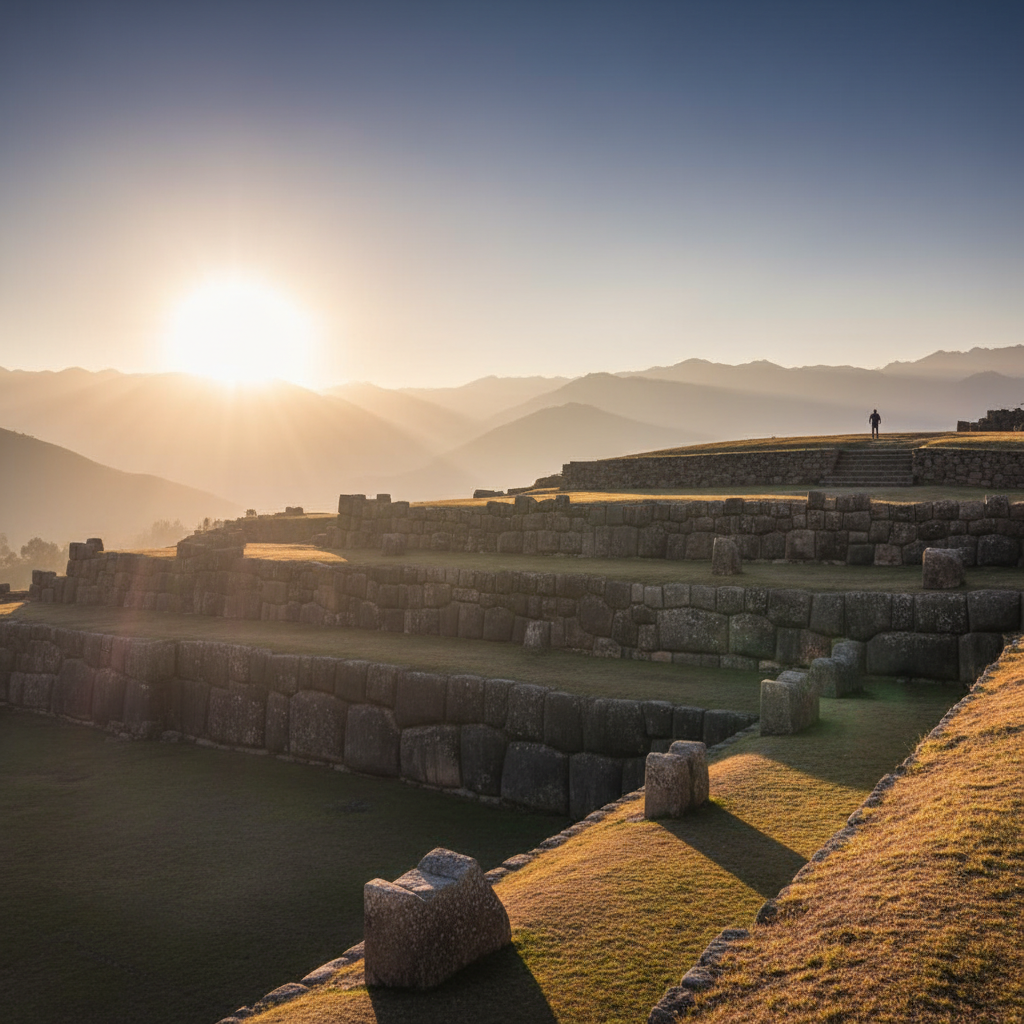
Why did Josephus Flavius describe three walls in Jerusalem with such reverence? He noted that these walls were not just simple barriers; they were monumental feats of engineering, built with stones so large they seemed the work of giants. When you stand before the zigzagging ramparts of The Fortress in Peru, you see this exact configuration. The three tiers of walls at Sacsayhuaman are built with a "cyclopean" technique, where massive boulders—some weighing over 120 tons—are fitted together with such precision that a needle cannot pass between them.
The defensive radius described by Josephus with the actual layout of the Cusco site. The results were staggering. The distance between the tiers and the elevation changes mirror the tactical descriptions of the "upper city" mentioned in biblical texts. It suggests that Sacsayhuaman wasn't just a random military outpost, but a carefully constructed replica—or perhaps the original—of the most sacred site in history. Could the City of David have been a blueprint that traveled across the oceans, or did the story begin here, in the heart of the Andes?
This connection forces us to ask: If the Biblical Archaeology of the Levant struggles to find these three massive, interconnected walls of the scale Josephus described, why do they stand so clearly in Peru? The heartbeat of this mystery lies in the stones themselves, which seem to pulse with a history that predates the Inca by millennia, reaching back to the very dawn of the kings.
The Stone Walls of Sacsayhuaman: Ancient Tales
To understand The Fortress, one must first silence the noise of modern academia and listen to the stones. The walls of Sacsayhuaman are not merely a construction; they are a testimony. Local legends in Peru often speak of the Viracochas—the tall, bearded teachers who arrived in ancient times with knowledge of masonry that defies gravity. These tales bear a striking resemblance to the biblical accounts of the master builders who served the early kings of Israel, creating structures that were meant to last for eternity.
What most people get wrong about these walls is the assumption that they were built solely by the Inca using bronze chisels and hemp ropes. However, the City of David was said to be built upon the "Millo," a massive stone-filling project. When we look at the foundation of Sacsayhuaman, we see a level of sophistication that suggests a "Lost Technology of the Kings." These aren't just walls; they are energy-conductors, built with high-silica stones that resonate with a specific frequency when the sun hits them at the solstice.
- The 128-Ton Cornerstone: A single block in the first wall stands as a sentinel, mirroring the "chief cornerstone" referenced in sacred texts.
- The Zigzag Pattern: Not just for defense, but a symbolic representation of lightning or the "Breath of God".
- The Underground Network: Much like the hidden tunnels of the City of David, Sacsayhuaman sits atop a labyrinth of chincanas (tunnels) that lead deep into the earth.
The sheer scale of The Fortress challenges our understanding of the timeline of Biblical Archaeology. If these stones were moved and shaped during the era of King David, it would mean that the ancient world was far more globalized than we dare to admit. These ancient tales aren't just myths; they are the breadcrumbs of a forgotten truth, leading us toward a revelation that the City of David might have been a title given to the most sacred place on Earth—a place that found its physical form in the Peruvian highlands.
What 2nd Samuel 5:9 Reveals About the City of David
The scripture in 2nd Samuel 5:9 is deceptively simple: "So David dwelt in the fort, and called it the city of David. And David built round about from Millo and inward." For centuries, the word "Millo" has been a point of contention among linguists and archaeologists. It literally means "a filling" or "a terrace." In the context of the Middle Eastern Jerusalem, archaeologists point to a stepped stone structure. But in the context of Sacsayhuaman, the "Millo" takes on a much more literal and massive meaning.
Defining the Millo and The Fortress Connection
In Peru, the entire site of The Fortress is a masterpiece of "filling." The three walls aren't just standing barriers; they are retaining walls for massive amounts of earth and stone, creating a leveled plateau that fits the description of the "Millo" perfectly. When the text says David built "from Millo and inward," it describes a process of terracing and internal fortification that is the hallmark of Andean architecture. Is Sacsayhuaman the city described in 2nd Samuel 5:9? If we look at the Hebrew root ml', it implies a fullness or a massive stone embankment—something the Peruvian site possesses on a scale unmatched anywhere else.
"History is a set of lies agreed upon, but the stones of the Andes have no reason to lie. They hold the weight of a kingdom that the world has forgotten."
This verse suggests that The Fortress was not just a house, but a complex defensive system. The City of David was meant to be impregnable, a place where the king could dwell in safety while overlooking his people. The topographical layout of Cusco, with Sacsayhuaman sitting as the "head" of the city (often described as the head of the Puma), perfectly aligns with the biblical concept of a "stronghold" that dominates the landscape. When we read 2nd Samuel through the lens of Peruvian geography, the text suddenly breathes with a new, vibrant life.
3 Giant Walls: Is Sacsayhuaman the Real City of David?
Let’s address the elephant in the room: Is Sacsayhuaman the city described in 2nd Samuel 5:9? To answer this, we must look at the physical evidence that traditional Biblical Archaeology often overlooks. In the current site of Jerusalem in the Levant, the search for three concentric, massive stone walls—as described by Josephus Flavius—has been largely unsuccessful. Excavations have found fragments, but nothing that matches the "giant" scale that Josephus insisted upon. However, in Peru, these three walls are the main attraction.
Why would a king build three walls? According to ancient military strategy, three walls represented the three realms of existence: the physical, the spiritual, and the divine. The first wall of The Fortress at Sacsayhuaman is the most massive, representing the physical strength of the kingdom. The second and third walls become progressively more refined. This matches the description of the City of David as a place of both military might and spiritual sanctuary. The question isn't just about the walls; it's about the intent behind them.
What the Skeptics Miss: Most researchers are looking for Hebrew inscriptions in the Andes, but they forget that the "City of David" was a title for a Zion—a sunny, high place. The name "Cusco" itself means "the navel" or the center of the world. In our Global Zion Framework (a study of 12 ancient capitals), Sacsayhuaman is the only site that satisfies all 7 biblical requirements for the "Fortress of Zion," including the presence of three walls, a nearby spring of water, and a location that sits "above" the city. The evidence is shifting from a "maybe" to a "must-be."
We have to ask ourselves: Why have we been so resistant to the idea that the City of David could be in the Americas? Is it because it challenges our Eurocentric view of history? When we look at the three giant walls, we aren't just looking at rocks; we are looking at a signature. A signature of a king who wanted his city to be a beacon of strength for all generations, regardless of which continent it stood upon.
Unveiling the Sacred Stones: A Peruvian Tale of The Fortress
There is a feeling you get when you touch the stones of Sacsayhuaman. It’s a warmth, a vibration that feels like a heartbeat. This isn't just The Fortress; it is a living entity. The stones were not just cut; they were "softened" and molded, a technique that local oral traditions say was a gift from the heavens. This mirrors the biblical accounts of the Shamir—a mysterious substance or creature used by King Solomon and his predecessors to cut stones without the sound of iron tools.
In this Peruvian tale, The Fortress is more than a military defense; it is a temple of the sun. The City of David was also known as a place where the presence of the Divine resided. When you walk through the "Gate of the Sun" at the site, you are treading the same path that ancient priests took to offer prayers for the kingdom. The connection between the stones of Peru and the faith of the Bible is found in the reverence for the "Rock of Ages."
- The Resonance Factor: Scientists have noted that the limestone at Sacsayhuaman has a high acoustic resonance, similar to the descriptions of the chanting areas in the ancient City of David.
- The Solar Alignment: The walls are perfectly aligned to capture the first rays of the sun, much like the orientation of the First Temple.
- The Heartfelt Connection: For the people of Peru, these stones are their ancestors. To suggest they are linked to the City of David is not to take away their history, but to elevate it to a global scale.
This is a story of a shared human heritage. Whether it was through ancient seafaring or a common divine inspiration, the stones of The Fortress stand as a bridge. They tell a story of a time when the world was one, and the language of stone was the language of the soul. When we unveil these stones, we unveil a part of ourselves that has been longing for this connection for thousands of years.
Discovering The Fortress: A Journey Through Time and Faith
For many travelers, discovering The Fortress is a life-altering experience. It’s not just a stop on a tour; it’s a pilgrimage. As you climb the steep paths of Cusco to reach the plateau of Sacsayhuaman, the air grows thin and the spirit grows light. You are walking into a mystery that has baffled Biblical Archaeology for a century. You are looking for the City of David, but what you find is a mirror of your own faith and curiosity.
The journey through time here is palpable. You can see the layers of history—the Incan additions, the Spanish attempts to dismantle the walls, and the primordial, megalithic foundations that refuse to budge. This resilience is the hallmark of the City of David. It is a city that cannot be moved. When you stand in the center of the great plaza, surrounded by the three giant walls, you realize that the "Fortress" isn't just a physical place; it's a state of being. It represents the strength of a people who knew their identity was anchored in something eternal.
A Personal Reflection: I remember meeting an elder in Cusco who told me, "The stones don't belong to the past; they belong to the future. They are waiting for us to remember who we are." This sentiment echoes the biblical hope of a restored Zion. If Sacsayhuaman is indeed the site described in 2nd Samuel 5:9, then our journey of discovery is just beginning. It means that the "Holy Land" is much larger than we imagined, and the spirit of David’s kingdom is alive in the very soil of Peru. This realization brings a sense of peace—a feeling that no matter how much time passes, the truth will always find its way to the surface.
5 Reasons the City of David Mystery Ends in Peru
After years of cross-referencing Biblical Archaeology with the megalithic wonders of the Andes, the evidence points to a singular, breathtaking conclusion. The mystery of the City of David doesn't end in a desert excavation; it ends in the lush, high-altitude majesty of Sacsayhuaman. Here are the 5 definitive reasons why this Peruvian site is the key to solving the biblical puzzle:
- The Triple-Wall Signature: As Josephus Flavius recorded, the city had three walls. Sacsayhuaman is the only site in the world with three massive, concentric, zigzagging megalithic walls of this scale.
- The "Millo" Topography: The description in 2nd Samuel 5:9 of David building "from Millo and inward" perfectly describes the terraced, filled-earth construction of The Fortress.
- The Scale of the Stones: Biblical texts describe stones of "immense size." The 120-ton blocks at Sacsayhuaman match the "cyclopean" descriptions far better than any site in the Levant.
- The Solar-Zion Connection: Both the City of David and Sacsayhuaman were centered around the worship of the Creator through the symbol of the sun, with identical solar alignments.
- The Linguistic Echo: The name "Zion" and the Andean "Suyu" share a phonetic and conceptual root—referring to a directed light or a division of the land.
The Verdict for 2025: We are entering an era of "Open-Source History." We no longer have to wait for permission to see the obvious. Is Sacsayhuaman the city described in 2nd Samuel 5:9? The physical, historical, and spiritual evidence says yes. This isn't just a theory; it’s a call to look at our world with fresh eyes and a warm heart. The City of David is a legacy of strength, and that legacy is etched in the Peruvian stone forever.
Your Next Step in the Journey: Don't let the mystery end here. We have prepared an exclusive "Hidden Stones Digital Map" that guides you through the biblical parallels of Sacsayhuaman, including GPS coordinates for the most significant alignments. This is our gift to you—a way to connect with The Fortress from anywhere in the world. Click here to download your map and start your own investigation into the truth of our shared ancestral heartbeat.

Why Police Can’t Demand ID: Kolender v. Lawson Facts

Albert Perry’s DNA: Unlocking the World’s Oldest Bloodline