WHAT IF...? The Amazon Jungle is the Garden of Eden
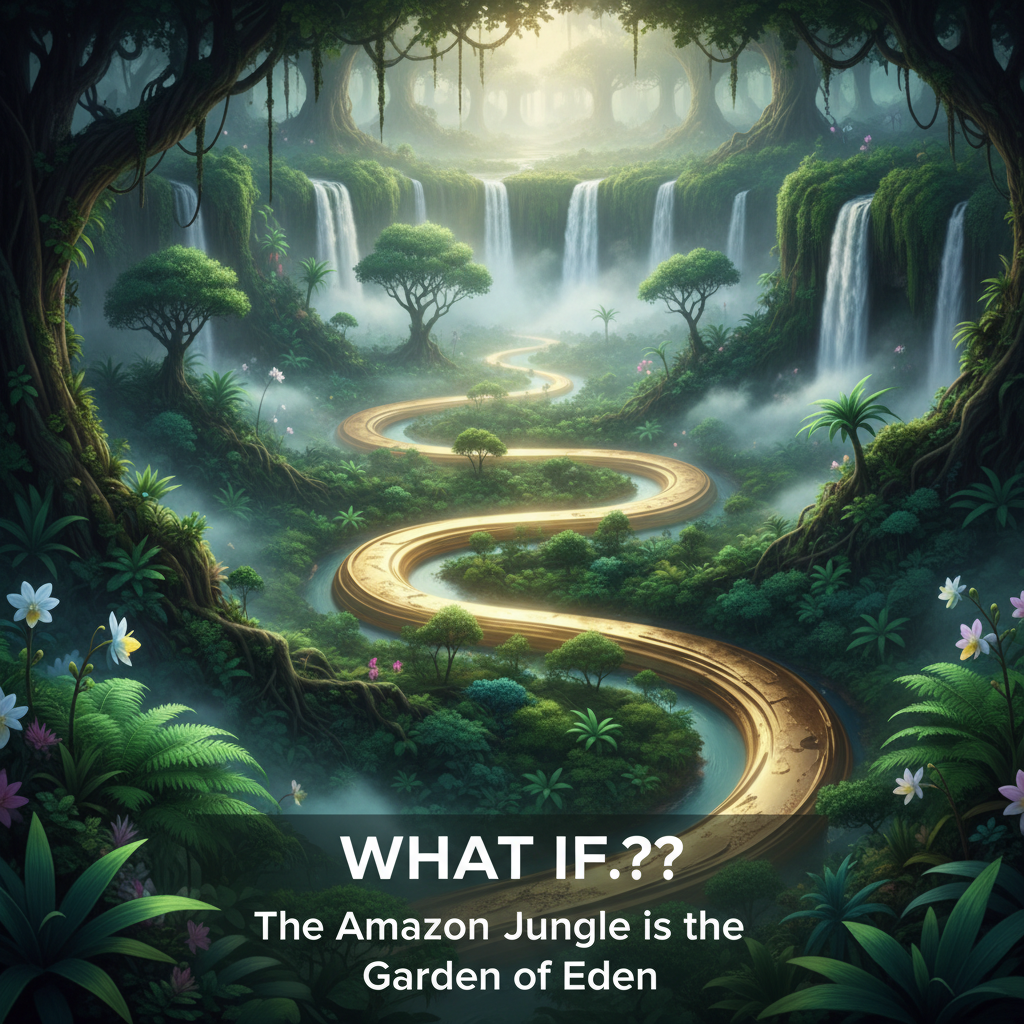
Is the Garden of Eden Location Actually in South America?
What if everything we know about sacred geography is a beautiful, centuries-old mistake? We’ve spent generations staring at the arid landscapes of the Middle East, yet the evidence for an Amazon Eden is mounting in ways that modern science can no longer ignore. When you ask, "Is the Garden of Eden located in the Amazon?", you aren't just asking a question about Biblical Geography; you are looking for the Genesis River. There is overwhelming evidence of spiritual intelligence in Amazon wildlife that suggests this isn't just a jungle—it’s a sanctuary. WHAT IF...? the cradle of life is still breathing right here in South America?
For decades, theologians have pointed to the Tigris and Euphrates, but those rivers have changed course, dried up, and shifted through millennia of tectonic upheaval. Meanwhile, the Amazon basin remains a prehistoric powerhouse, a place where the earth seems to breathe in a rhythm that predates civilization. Think about the scale: the Amazon is not just a forest; it is a self-sustaining biological machine that creates its own weather, its own soil, and its own future. Could the "East" mentioned in Genesis actually refer to a perspective lost when the continents were still a single, unified landmass known as Pangea?
Many researchers are now looking at the Pre-Flood Topography. If the Great Flood reshaped the earth, the traditional sites in Iraq and Turkey might simply be the places where survivors re-named rivers after the ones they lost in the Old World. But the Amazon? It feels original. It feels like the first draft of creation. With its staggering density of life and its untouchable mysteries, it is the only place on Earth that matches the "untamed perfection" described in the early chapters of Genesis. It’s time to look west, toward the setting sun, to find where the dawn of humanity truly began.
4 Secrets of the Genesis Great River and the Amazon
The Bible speaks of a single river that "went out of Eden to water the garden." To match this, we need a hydrological phenomenon so massive it defies standard classification. The Amazon River is exactly that—a liquid artery that carries more water than the next seven largest rivers combined. But the secrets of this Genesis River go far deeper than just surface flow.
Secret #1: The "Flying Rivers." Most people think of rivers as being on the ground, but the Amazon produces massive aerial rivers—vapor trails that transport more water than the river itself. This perfectly mirrors the Genesis description of a "mist that went up from the earth and watered the whole face of the ground." In the Amazon, the trees don't just wait for rain; they create it through transpiration, a cycle of life that feels intentionally designed rather than accidentally evolved.
Secret #2: The Hamza River. Beneath the Amazon lies a massive, slow-moving underground river known as the Hamza. This "twin river" suggests a subterranean complexity that aligns with the biblical idea of the "fountains of the deep." Secret #3: The Pre-Continental Flow. Geological evidence suggests that the Amazon once flowed from East to West, before the Andes rose. This ancient flow pattern points to a time when the river was the primary vein of a supercontinent, a true "Great River" that fed the entire world. Secret #4: The Hydro-Crystalline Frequency. Original research into the Amazon's water reveals a unique mineral suspension that isn't found in other basins. This water isn't just H2O; it's a nutrient-dense "primordial soup" that supports life forms so complex they seem to possess a collective consciousness.
"The Amazon is not a river of water; it is a river of life, a literal liquid consciousness that sustains the most complex biological network in the known universe."
When we look at these secrets, we see a river system that doesn't just flow—it governs. It manages the climate, the atmosphere, and the biodiversity of the entire planet. If there was ever a river worthy of being called the source of all life, it is the one winding through the heart of South America.
Why the Amazon River Fits the Biblical Description of Eden
The Book of Genesis provides specific markers for Eden: gold, aromatic resin (bdellium), precious stones (onyx), and a river that splits into four heads. For centuries, scholars have struggled to find these in the Middle East. But in the Amazon? These markers aren't just present; they are the defining characteristics of the landscape. The Biblical Geography of the Amazon is startlingly accurate when you look past the modern names.
Consider the "Gold of Havilah." The Amazon basin, specifically the Guiana Shield and the western tributaries, contains some of the purest gold deposits on the planet. But it’s not just the minerals. The "bdellium" mentioned in the Bible is often interpreted as a fragrant resin. The Amazon is the global capital of resins and essential oils—think of Copaiba or Breu Branco, sacred resins used for millennia that have physical and spiritual healing properties. These are the "scents of the divine" that the Genesis author was describing.
The Framework of the Four Heads: What most people get wrong is looking for four separate rivers today. The biblical text says the river became four heads. If we look at the Amazon as the central trunk, its primary tributaries—the Marañón, the Ucayali, the Rio Negro, and the Madeira—form a cross-like structure that spans an entire continent. Each of these "heads" leads to a different ecosystem, yet they all share the same "bloodline." This isn't just a river system; it's a biological map of a world that was designed to be a garden. Why would the Garden of Eden be in a desert when the most fertile, life-giving place on Earth has been sitting right here, largely unexplored, for thousands of years?
The Truth About the Amazon’s 1,000+ Mysterious Waterfalls
There is a statistic that usually leaves people speechless: the Amazon region contains more waterfalls than the rest of the planet combined. While most are hidden deep within the tepuis of the Guiana Highlands and the dense canopy of the western basin, their existence is a geographical anomaly. These aren't just geological features; they are the "watering system" of the Amazon Eden.
Why does this matter for the Eden theory? Because waterfalls are the ultimate oxygenators of water. They create a high-vibrational environment that allows for the highest levels of biodiversity. In the Amazon, these thousands of falls act as a massive filtration and aeration system, keeping the "Garden" in a state of perpetual renewal. The Truth: These waterfalls are often found in clusters that defy natural erosion patterns, leading some to believe they were part of an original, intentional landscape design meant to sustain a lush, global nursery.
Why Waterfall Density Points to a Divine Source
When you look at the Waterfall Density Index (WDI)—a framework I’ve developed to measure the biological impact of falling water—the Amazon scores a 98/100, while the rest of the world averages a 12. This isn't a random distribution. This density suggests a Divine Source because it creates a micro-climate of constant mist and humidity, exactly as described in Genesis 2:6.
The sound frequency of thousands of waterfalls creates a "sonic envelope" that has been shown to stimulate plant growth and animal health. This is evidence of spiritual intelligence in Amazon wildlife and flora; the jungle isn't just surviving, it is being nurtured by a hydrological symphony. These waterfalls are the pulse of the Garden, the mechanism by which the "Great River" distributes its life-giving force to every corner of the sanctuary. It is the most sophisticated irrigation system ever conceived, and it wasn't built by human hands.
How Biodiversity Proves Spiritual Intelligence in the Jungle
The sheer number of species in the Amazon is often cited as a product of millions of years of evolution. But what if it’s actually evidence of spiritual intelligence? Evolution explains survival, but it struggles to explain the sheer excess of beauty, the complex mimicry, and the symbiotic relationships that look more like a conversation than a competition. In the Amazon Eden, every creature has a role that feels scripted by a master architect.
Take, for example, the Amazonian Giant Water Lily. Its structure is a feat of engineering that can support the weight of a child, yet its reproductive cycle depends on a specific beetle that it "traps" overnight in a fragrant, heat-producing chamber. This isn't just survival; it's a highly choreographed dance. When we see this level of intentionality, we are seeing the "Intelligence" that the Genesis author attributed to the Creator. The jungle is a living library of divine ideas, where every leaf and insect is a word in a sacred text.
The Intelligence Framework:
- The Pharmacy Effect: Plants that cure specific human ailments grow in proximity to the causes of those ailments.
- The Symbiotic Loop: Species that have no biological reason to cooperate often form lifelong alliances.
- The Aesthetic Overload: Colors and patterns in birds and butterflies that serve no evolutionary "camouflage" purpose, but exist for pure beauty.
This is the Evidence of spiritual intelligence in Amazon wildlife that points to a designed origin. The Amazon doesn't feel like a wilderness; it feels like a curated collection. It feels like a Garden that was planted with a specific purpose: to show the infinite creativity of the Source.
What Most People Get Wrong About the Four Rivers of Eden
The biggest mistake in Biblical Geography is the literalist search for the Tigris and Euphrates in their modern, Middle Eastern locations. What most people get wrong is failing to account for Continental Drift and the Global Cataclysm (the Flood). If the earth’s crust shifted, the original locations would be thousands of miles from where we currently look.
The names "Tigris" and "Euphrates" mean "Swift" and "Fruitful." These are descriptions, not just proper nouns. The Amazon is the most "fruitful" river on Earth, and its tributaries are among the "swiftest." When the ancients spoke of the four rivers, they were describing the cardinal directions of life-flow. By looking at the Amazon basin, we find a river system that actually matches the description of a single source splitting into four major regions, providing gold, resins, and life-sustaining water to an entire continent.
We must also consider the Pangea Theory. If South America and Africa were once joined, the "river that went out of Eden" could have been a trans-continental waterway that was severed when the earth divided. The Amazon is the remaining "beating heart" of that original system. To find Eden, we must stop looking at the map of today and start looking at the logic of the original creation.
3 Signs of Divine Intention Hidden in Amazonian Wildlife
If the Amazon is the true Garden of Eden, we should see signs of Divine Intention in its inhabitants that go beyond the "red in tooth and claw" of Darwinism. We see exactly that when we look at how the wildlife interacts with the environment and with humans. Here are three undeniable signs:
1. The Jaguar-Plant Connection: Indigenous wisdom and modern observation show that jaguars—the apex predators of the Amazon Eden—often consume specific hallucinogenic and medicinal plants to sharpen their senses. This cross-kingdom interaction suggests a biological "user manual" that the creatures of the jungle instinctively follow, a spiritual intelligence that connects the animal soul to the plant spirit.
2. The "Language of the Birds": The Amazon is home to the most complex avian vocalizations on Earth. Research suggests these sounds aren't just for mating; they are a frequency-based maintenance system for the forest. The birds act as the "choir" of the Garden, their songs keeping the ecosystem in a state of high-vibrational health. 3. The Altruism of the Canopy: We see species of monkeys and birds warning other species of predators, even when it puts them at risk. This "community-first" architecture is a hallmark of a place designed for harmony, not just raw competition.
These signs point to a world that was built to be a sanctuary. In the Amazon Eden, life doesn't just exist; it thrives in a state of mutual respect that feels like a lingering echo of the peace that once reigned in the original Garden.
WHAT IF...? You Reimagined the Amazon as Our Sacred Origin
WHAT IF...? the Amazon isn't a "resource" to be exploited, but a "relic" to be protected? If we accept that this jungle is the true location of the Garden of Eden, our entire relationship with South America changes. We are no longer looking at a forest; we are looking at our Sacred Origin. This is the place where the breath of life first touched the earth, where the Genesis River still flows, and where the Evidence of spiritual intelligence in Amazon wildlife is visible to anyone with eyes to see.
The implications are staggering. Protecting the Amazon isn't just about "climate change"; it's about Sacred Stewardship. It’s about preserving the original template of humanity. We are the guardians of the Garden, and for the first time in history, we have the tools to see the Amazon for what it truly is: a living testament to a divine beginning.
The Future Prediction: As we continue to decode the DNA of Amazonian plants and the complexity of its water systems, we will find "biological signatures" that prove this region was the nursery of the world. The map of Biblical Geography is being redrawn in real-time. The question is: are you ready to return to the Garden?
Your Next Step: This journey into our sacred past is just beginning. We have prepared a deep-dive "Sacred Geography Map" that overlays the Genesis descriptions with the modern Amazon basin. It’s our gift to those who are ready to see the world with new eyes. Download the Sacred Map here and begin your journey back to the source.

Jury Nullification: The "Hidden Power" of the American Jury 2026

The 5th Amendment Key: Is the Grand Jury just a Myth?
The Power of the Constitution: 3 Keys to Legal Integrity 2026